Start in the Historic District, a National Historic Landmark District designated in 1966 and one of the largest urban historic districts in the country. Exterior changes there that are visible from the public right-of-way need a Certificate of Appropriateness, which goes through the Historic District Board of Review at the Metropolitan Planning Commission. That changes how owners hire. A homeowner replacing windows, rebuilding a porch, replacing siding, or swapping a roof isn't just choosing a price. They're choosing someone who understands the review process, can work with plaster walls, old wiring, wood windows, and original materials, and won't get the project stopped halfway. Before they call, they search for proof: past historic projects, license details, reviews that mention old houses. A contractor with a thin website loses that job before the phone rings.
The older housing doesn't stop at the Historic District's edge. The Victorian District, Ardsley Park, and Midtown hold bungalows, revival-style homes, and large early-1900s houses, many raised on piers over crawlspaces. Southside, Isle of Hope, Thunderbolt, and the islands east of town (Wilmington Island, Whitemarsh Island, Skidaway Island) are a mix of mid-century and later houses. The calendar for all of it is long, hot, and humid. Cooling runs from spring well into fall, and ductwork in a crawlspace or attic sweats and fails early. Wet crawlspaces invite wood rot and termites, and Formosan termites are established in coastal Georgia, including Savannah. Old homes also bring the repair-or-replace question to every trade: wiring that predates modern panels, galvanized plumbing, and roofs that can't be rushed.
Then there's the other Savannah. West and south of the city, Pooler, Port Wentworth, Garden City, Richmond Hill, and Rincon have been adding homes fast, pulled by port, distribution, and manufacturing jobs. Pooler and Port Wentworth have grown much faster than the city itself. Those buyers are different people with a different search. They want installs, new-system service, warranty work, fence and deck projects, and a contractor who actually serves their subdivision, not just one with a Savannah address. Most of the city is a Georgia Power customer, licensing questions are state-level (a Georgia residential or general contractor license, plus separate state licenses for electrical, plumbing, and conditioned-air work), and some contractors also cross the state line to Bluffton and Hilton Head Island. One company, two very different customers, and two sets of pages.
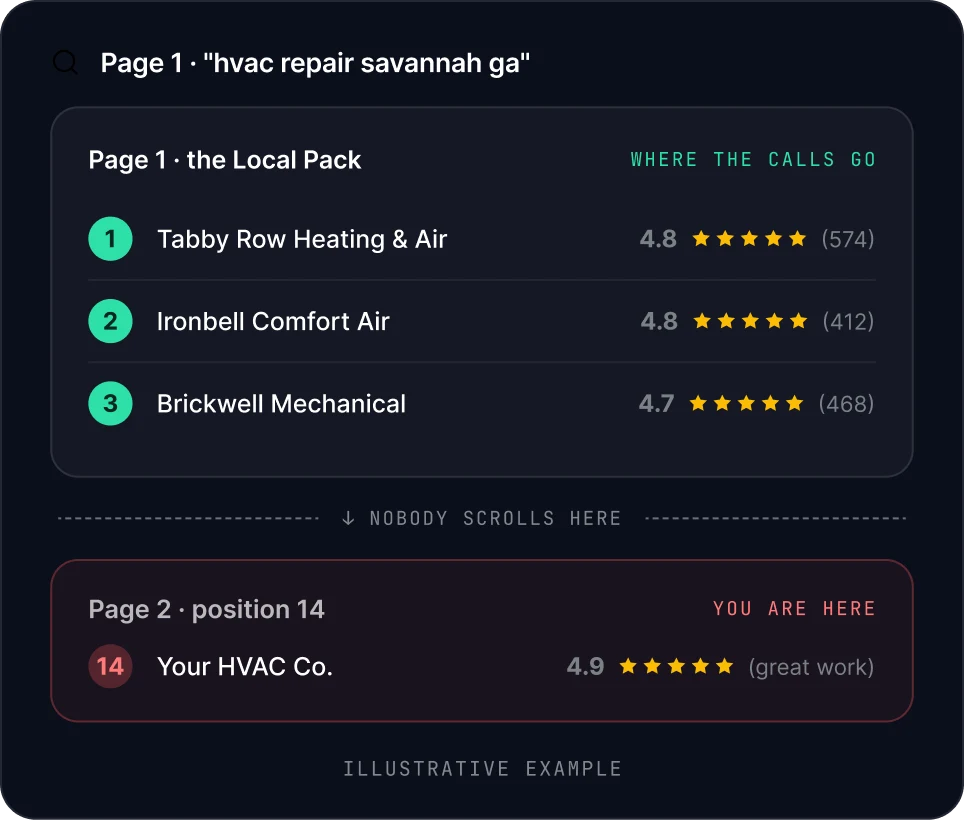
Here's the honest picture of the competition. Search "hvac repair savannah ga" and a three-company Map Pack sits on top. Below it are mostly the homepages of local HVAC companies, a Yelp results page, a commercial-bid directory, and a national franchise page. Several of those homepages carry a lot of links, but each pulls only a trickle of search traffic, and almost none answer what an owner of a 100-year-old house or a new-build homeowner in Pooler is actually typing. This is a real market, so expect it to take longer than in a small city. But pages built for the historic core, pages built for each western suburb, a strong Google Business Profile with your Georgia license and reviews front and center, and steady local authority are enough to win.