Long Beach's housing stock is older than most of Southern California's. California Heights was laid out in the 1920s and holds roughly 1,500 Craftsman, Spanish Colonial Revival, and Tudor homes. Belmont Heights has houses dating to the early 1900s, Rose Park and Bluff Heights are full of Craftsman bungalows, and the city has designated well over a dozen historic districts. Homes of that age fail in predictable ways. Galvanized supply lines clog and corrode from the inside, cast-iron drains crack under the slab, and original wiring and small panels can't carry a modern kitchen, an EV charger, or central air. Owners rarely call the first number they find. They search for the repipe, the panel upgrade, or the sewer line fix, compare a few companies, and then ask a neighbor.
The coast adds its own wear. A marine layer sits over the shoreline most mornings, and the salt air that comes with it speeds up corrosion on roof flashing, gutters, window hardware, and exterior trim. Wood-frame houses in Belmont Shore, Naples, and the Peninsula take that exposure year after year, so roof, window, and stucco work never really stops. Move inland to North Long Beach, Lakewood Village, and the post-war tracts around Los Altos and the Traffic Circle, and the picture flips: summers run noticeably hotter than at the water, old furnaces and undersized AC units get pushed hard, and the first 95-degree week sends homeowners searching for repair and replacement. The city's own Long Beach Utilities supplies gas and water, so gas-line, water-heater, and shut-off questions here come with local rules that contractors in neighboring cities don't deal with.
The market also splits by neighborhood and by language. Bixby Knolls, Cal Heights, and Wrigley are older-home and remodel country. Naples and Belmont Shore mix canal-side and beach-adjacent homes with high-value renovations. Lakewood Village, Los Altos, and the Eastside hold mid-century ranch homes that want kitchens, windows, and system replacements. North Long Beach, Cambodia Town along Anaheim Street, and the Westside are dense, bilingual neighborhoods where many searches happen in Spanish or Khmer, and where multi-unit owners hire often. The employment base is broad and steady: the port, the airport, the hospitals, the university, and the shipyard-era trades that built the city. Permits run through Long Beach Development Services rather than Los Angeles, and the city expects a California contractor license plus a Long Beach business license. Homeowners who know that look for local contractors who do too.
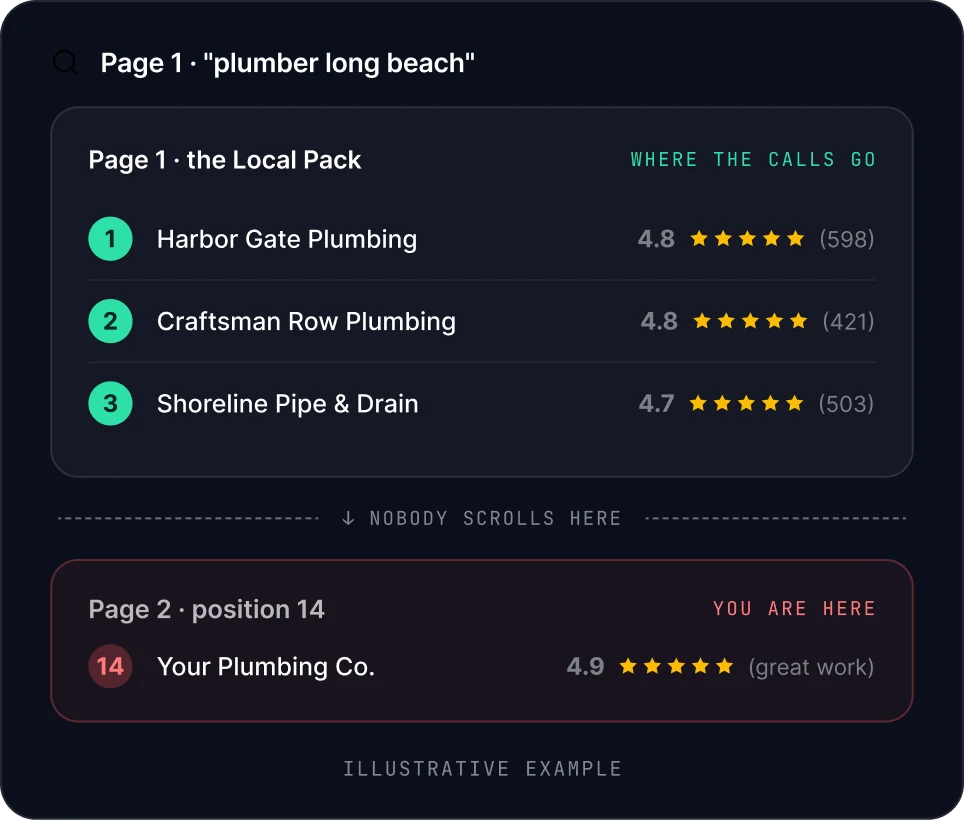
Here's the catch, and the opportunity. Long Beach shares a search market with the whole LA metro. Search "plumber long beach" and the Map Pack is led by a national franchise, a Reddit thread asking for recommendations sits at #2 in the organic results, a franchise page is #3, and a Yelp search page is #4. Yet the independent contractor sites underneath have low authority and a thin local story. That gap is the opening. A contractor who builds real neighborhood pages for Bixby Knolls, Belmont Heights, and Lakewood, a Google Business Profile with the CSLB license and reviews front and center, and a few genuine local links can earn real position here. It won't be fast, because the metro is crowded. It is winnable, and the contractors who start now will be hard to dislodge.