
It’s 102 degrees in Dallas. Megan’s AC just quit. She googles why her vents are blowing warm air and watches a YouTube video on frozen coils. Checks the map pack for AC repair near her. Asks ChatGPT for a second opinion. Posts in her neighborhood Facebook group and on Nextdoor: "Who do you guys use for AC?"
After 4 steps, she finally calls an HVAC company. It was the name that kept showing up along the way. That’s search everywhere optimization in action.
Your Google rankings may look fine, yet fewer people click through to your website. Your customers haven’t gone anywhere. They’re just checking more places before they call.
So, how do you optimize for clients like Megan? In this search everywhere optimization guide, you’ll learn:
- What search everywhere optimization means (no marketing jargon, we promise)
- The 4 steps homeowners take before they reach out to just a few contractors
- Which platforms deserve your time (and which ones you can skip)
- A 7-step plan you can start this month, whether you run one truck or ten
- How to measure what pays the bills: calls, booked jobs and revenue
Key Takeaways
- Search everywhere optimization gets your business found and trusted everywhere homeowners look: Google, Maps, AI assistants like ChatGPT, YouTube, Nextdoor, and review sites.
- It builds on SEO. Your website and Google Business Profile are still the foundation that AI tools pull from.
- You don’t need every platform. 2-3 channels that are executed well are more than enough.
- Go beyond rankings. Measure results by the calls, booked jobs, and revenue each channel brings in.
What Is Search Everywhere Optimization?
Search everywhere optimization is the practice of making your business visible and trustworthy everywhere homeowners search, including web search engines like Google, Google Maps, ChatGPT and other AI assistants, YouTube, Facebook, Nextdoor and review sites like Yelp.
You may also see search everywhere optimization shortened to SEvO or SEOx. Don’t be confused. It’s the same thing, different letters.
Rand Fishkin, co-founder of SparkToro, credits the term to Ashley Liddell of the UK agency Deviation. Fishkin summed up his take in one headline: "It’s still SEO," i.e., search engine optimization.
Strip away the jargon, and the search everywhere optimization definition for a contractor comes down to one question: when a local homeowner needs your trade, does your name show up everywhere they check?
If you’re thinking, "Well, then it sounds a lot like regular SEO," here’s how the two compare.
How Is Search Everywhere Optimization Different From Traditional SEO?
Traditional SEO gets your website ranked on Google, while search everywhere optimization gets your business found anywhere online that homeowners look, from Google Maps to ChatGPT to the neighborhood Facebook group.
| Traditional SEO | Search everywhere optimization | |
|---|---|---|
| Main goal | Rank your website on Google | Get your business seen and chosen wherever homeowners look |
| Where it happens | Google and Bing results | Google, Maps, AI assistants, YouTube, social media, review sites, neighborhood apps |
| What you work on | Website pages, links, technical health | Website plus Google Business Profile, reviews, videos, listings and mentions on other sites |
| What success looks like | Rankings and website visits | Calls, booked jobs, revenue and searches for your company name |
Is SEO out? Not at all. Research by ZipTie.AI analyzing 25,000 user searches found that websites ranked #1 on Google appear in AI search answers 25% of the time.
What does this mean? AI still relies on foundational SEO practices and structured data. Your website and online presence should offer clear, trustworthy answers that AI tools can easily read, summarize, and cite.
Fair warning: as we go deeper, there are quite a few new buzzwords you’ll need to know. Here’s what they mean in plain English.
Key Terms for Modern Search and AI Discovery
You don’t need to memorize these, but you’ll see them in this guide (and in every agency pitch that lands in your inbox). Here’s what each one means for your business.
| Term | What it means for your business |
|---|---|
| AI Overviews | The AI-written summary at the top of Google that can answer based on search intent: "why is my furnace short cycling?" before anyone clicks a website. |
| Google AI Mode | A chat-style Google search where homeowners ask follow-up questions ("which of these offers financing?") and get AI answers with links to sources. |
| Generative engine optimization (GEO) | Work that helps ChatGPT, Gemini, Perplexity, and other AI tools understand, trust, and recommend your business, also called answer engine optimization (AEO) or AI search optimization. |
| Map pack (local pack) | The 3 businesses Google shows on a map for searches like "plumber near me," which is prime real estate for emergency calls. |
| Google Business Profile | Your free listing on Google Search and Maps, with reviews, photos, hours, and a call button. |
| Zero-click search | A search that ends without a website visit, because the answer, phone number, or map was right on the results page. |
| Brand mentions | Your company name showing up on other sites, forums, news stories, or directories, with or without a link, which AI tools read when deciding who to recommend. |
Why Does Search Everywhere Optimization Matter for Contractors Now?
Search everywhere optimization matters because homeowners check several websites, directories, AI tools, and even traditional search engines. Fewer of those checks end on your site.
The bigger the job, the longer the checklist.
A furnace filter gets a 5-minute Google search and maybe ends on Amazon. A planned $15,000 roof replacement gets a week of reviews, YouTube videos, and Nextdoor neighbor opinions.
That roof replacement shopper isn’t the exception. Recent research shows most homeowners shop this way now:
- 75% of consumers used more than one channel to find a local business, and 52% started on Google Search (BrightLocal, 2026).
- 45% used AI tools for local business recommendations in the past 12 months (BrightLocal, 2026).
- When Google shows an AI summary, people click a regular result on just 8% of visits, versus 15% without one (Pew Research Center, 2025). That’s nearly 50% of the clicks gone.
- 68% of US Google searches ended without a single click in early 2026 (SparkToro/Similarweb, 2026).
On your end, it might look strange.
Your website traffic slides, but customers still say they "saw you on Google." Someone mentions ChatGPT recommended your company two zip codes over. New customers arrive having already read your reviews on 2-3 sites. And the marketplace leads you buy keep getting pricier, with 3 other contractors bidding on the same homeowner.
For contractors: Those clicks didn’t disappear. They moved to Google Maps, AI answers and searches for your company name. They’re not coming back to the blue links.
So, what does the path from "my AC is dead" to "you’re hired" actually look like? Let’s go back to Megan.
How Does a Homeowner Actually Find a Contractor Today?
Rarely in one search. Most homeowners take 5 steps, from the first search to the call: they look up the problem, build a shortlist, get a second opinion, check who they can trust, then call.
Remember Megan from earlier? Here’s what that looked like for her.
- The problem search. Megan googles "AC blowing warm air." An AI Overview lists the likely culprits, from a frozen coil to a dead capacitor. One YouTube video later, she knows this isn’t a DIY job.
- The shortlist. She searches "AC repair near me." The map pack shows 3 companies. One has 3.8 stars. It’s out.
- The second opinion. She asks ChatGPT for the best same-day AC repair in her part of Dallas. It names 2 companies, and one of them was already on her map pack list.
- The trust check. She posts in her neighborhood Facebook group and on Nextdoor: "Who do you guys use for AC?" 2 neighbors tag the same company.
- The call. Megan googles that company by name, checks its website for weekend hours and financing, and taps "Call."
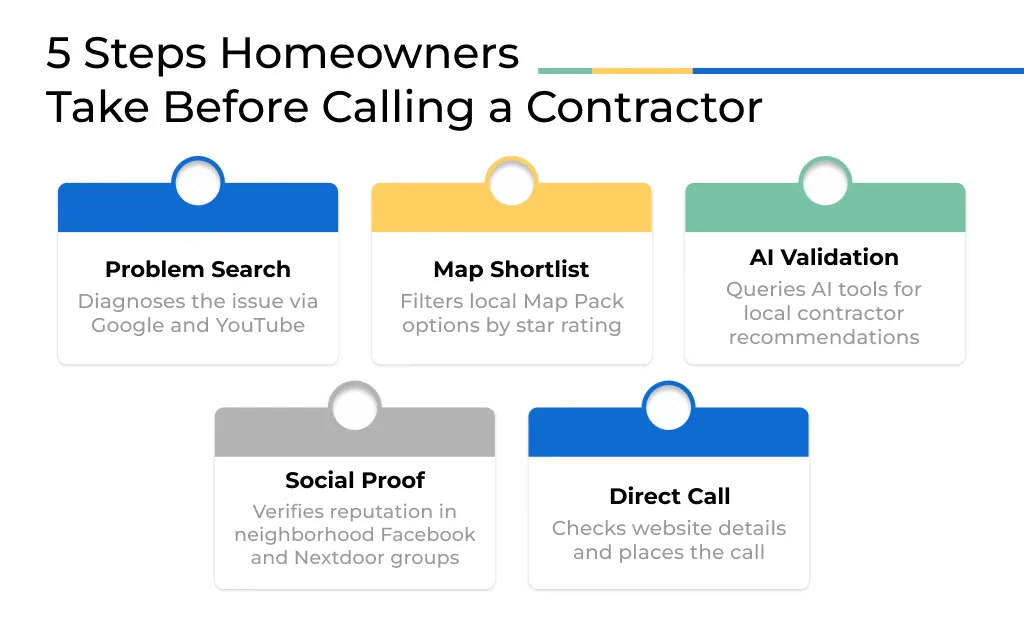
Did you notice where the job was won? Not at the call, because by then Megan had already decided. The winner earned it at steps 2-4.
Megan’s shortlist was never going to be long, either. 72% of consumers look at 3 or fewer businesses before choosing (BrightLocal, 2026). Miss the first few steps, and you won’t make the shortlist. Our HVAC local SEO guide shows how to win those steps.
P.S. Does the path change with the trade? Yes, yes, and yes.
Storm damage is a different story. After a hailstorm, it’s a sprint: homeowners with a leaking roof call the first credible roofer they find in the map pack and read reviews while they’re on hold.
Landscaping and remodeling run the other way. Homeowners spend 2-3 months saving ideas on Pinterest, Instagram, and Houzz before they search for a contractor at all.
So the question becomes: beyond Google, where are homeowners looking, and which stops deserve your time?
Where Are Homeowners Searching Besides Google?
Google Maps and your Google Business Profile still come first. After that, homeowners turn to AI assistants like ChatGPT, YouTube, Facebook groups and Nextdoor, review sites, Reddit, and visual platforms like Instagram and Pinterest.
We’ve ranked each stop by how much it matters for a local service business.
Google Search, Maps and Your Business Profile
Did a client’s water heater burst at 6 a.m.? At that point, they’re not casually reading blog posts. They search "plumber near me," scan the map pack, and call one of the top plumbers.
Your Google Business Profile is the load-bearing wall of everything in this guide. Let it sag, and the rest comes down with it.
So, keep your categories, services, service area, authentic job photos (no AI-generated images if you can help it), and reviews complete and current. Our Google Maps marketing guide covers the details.
But your next client isn’t the only one reading your profile.
AI Assistants: ChatGPT, AI Overviews, AI Mode, Gemini and Perplexity
Ask ChatGPT for "the best roofer in Plano," and it won’t flip a coin. It reads your website, Google Business Profile, reviews, directory listings, local news and forum threads, then recommends the companies whose details line up.
Think of it as a building inspector. If Google lists your hours one way and Yelp another, you don’t pass. AI Overviews, AI Mode, Gemini, and Perplexity need consistency.
Strong local SEO is the starting point. Learn more about AI search optimization and how it connects to local SEO.
YouTube and TikTok
For certain problems, you need to watch, not just read about it.
In a Frontdoor survey of homeowners, 73% of DIYers said they turn to YouTube when they get stuck on a project. A stuck DIYer is one bad video away from calling a repairman. Make sure it’s your video.
3 video ideas worth shooting this month (depending on your trade):
- What happens during a furnace tune-up
- What hail damage looks like on a roof, up close
- How much a panel upgrade costs in [your city]
YouTube SEO and TikTok SEO aren’t complicated: phrase titles as questions, put your city in the description, and turn on captions.
And while videos lend you the trust factor, neighbors earn you the referral.
Facebook, Nextdoor and Neighborhood Groups
Remember Megan’s Nextdoor post? 2 neighbors tagged the same company, and it got the call.
That’s not a fluke. In Tinuiti’s survey of homeowners who hired a professional in the past year, 29% found them on social media. Facebook beat all other platforms combined.
To be the name neighbors tag:
- Complete your Facebook and Nextdoor business pages
- Help out in local groups as a pro, not a salesperson
- Ask happy customers to recommend you on Nextdoor
Learn more about social media marketing for home service companies here. And while neighbors vouch out loud, review sites put it in writing.
Review Sites and Directories: Yelp, Angi, BBB, Houzz and Thumbtack
Imagine 2 roofers with the same quote. One has 4.8 stars on Angi. The other has a BBB complaint nobody answered. Easy call, right?
Every listing does double duty: one more place to get found, and one more source AI tools check before recommending anyone.
Keep your name, address, and phone number (NAP) identical everywhere. "Smith Plumbing LLC" on Yelp and "Smith Plumbing & Drain" on Angi look like 2 different companies. And answer your reviews, good and bad.
For the unfiltered version, homeowners head to Reddit.
Reddit and Local Forums
Some homeowners tack "reddit" onto their search, like "best roofer Dallas reddit," because they trust strangers more than ads.
Reddit SEO for contractors is simple: show up in your city’s subreddit, r/HVAC or r/Roofing, and answer questions honestly and accurately. No pitches, no links to your quote form. Redditors can smell an ad from a mile away.
Some trades, though, sell better with pictures.
Instagram, Pinterest and Houzz for Visual Trades
A homeowner planning a backyard redo might save 40 patio photos on Pinterest. If one of them is yours, you’ve got a head start.
To every landscaper, remodeler, painter, and deck builder: let before-and-after shots do the selling. Pinterest SEO needs captions that name your service and the city, like "cedar deck build in Frisco, TX." Same goes for Instagram and Houzz.
Once you have the visuals down, think about the searches nobody types at all.
Voice Search: Siri, Alexa, and Google Assistant
"Hey Siri, find an electrician near me," says the homeowner standing in a dark kitchen.
Voice search now runs through the same AI assistants and map apps as everything else.
Voice search optimization starts with claiming your free Apple Business Connect and Bing Places listings, since assistants pull from them. Be sure to match the details to your Google Business Profile.
Now that you know what to optimize for, let’s talk about the other side.
What Can Contractors Skip? (App Stores and Online Shopping Search)
Plenty of marketing guides say to optimize for app stores and Amazon, too. For a contractor, that’s mostly wasted effort. Nobody downloads a new app to find a roofer. Amazon SEO won’t book you a single furnace install.
The exception: marketplace apps like Angi, Thumbtack and Yelp. Homeowners do search inside them, so treat each one like a directory listing.
Here’s the whole map, sorted by priority:
| Platform | What homeowners do there | Trades that benefit most | Priority |
|---|---|---|---|
| Google Search, Maps and Business Profile | Find nearby pros, compare reviews, call | All trades | Must have |
| AI assistants (ChatGPT, AI Overviews, Gemini) | Ask for recommendations, costs, and who to trust | All trades, especially roofing, HVAC replacement and remodeling | High |
| YouTube | Diagnose problems, see how a job is done | HVAC, plumbing, electrical, roofing | High |
| Facebook and Nextdoor | Ask neighbors for recommendations | All local trades | High |
| Review sites (Yelp, Angi, BBB, Houzz) | Check ratings, compare pros | All trades | Medium to high |
| TikTok and Instagram | Watch short videos and before-and-after posts | Landscaping, remodeling, painting, roofing | Medium |
| Save ideas for future projects | Landscaping, remodeling, decks, kitchens | Medium for visual trades | |
| Reddit and forums | Ask for honest opinions and price checks | HVAC, roofing, plumbing, solar | Low to medium |
| Voice assistants (Siri, Alexa, Google Assistant) | Ask for a nearby pro hands-free, often in an emergency | Plumbing, electrical, HVAC | Low (covered by your listings) |
| App stores and Amazon | Rarely used to hire a contractor | Very few | Skip |
Notice something? Half of these stops are run by someone else, and that changes how you play them.
What Can You Control, and What Can You Only Influence?
Search-based optimization covers two kinds of stops: the ones you run yourself, and the ones other people run about you. You control your website and profiles. You can only influence reviews, neighbor recommendations, and what AI tools say.
It’s like any job. You control the workmanship. You can’t control what the homeowner tells the neighbors at the next block party. Ultimately, great work makes the story easy to tell.
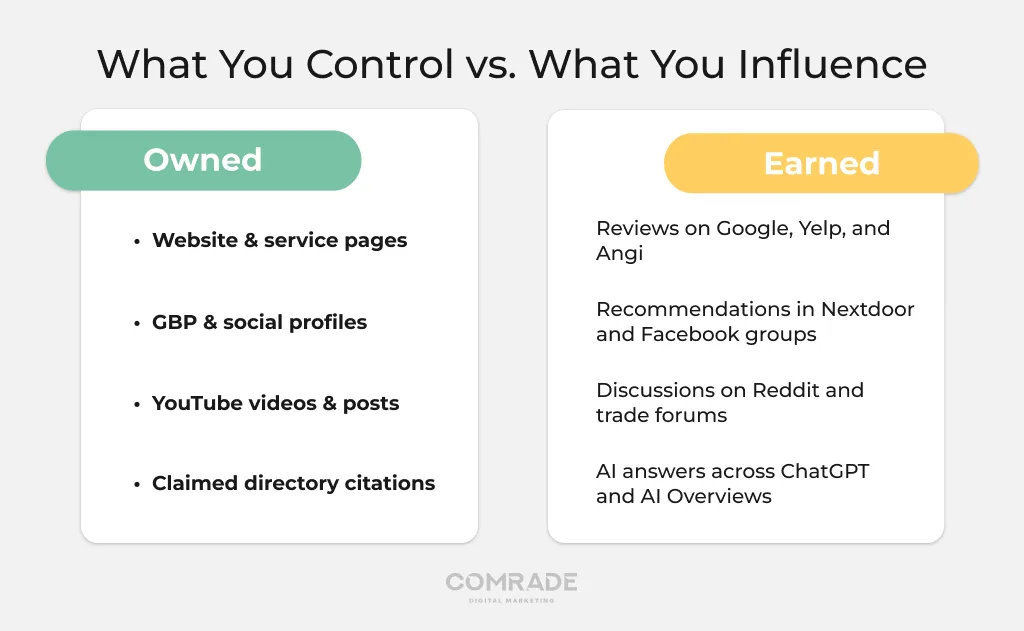
Here’s the catch: AI tools put a lot of weight on the right-hand column.
What customers, neighbors, and forums say about you often carries more pull than what you say about yourself.
The left column is your foundation. The right column is where you earn the recommendation.
Will the Next Customer Find You?
Don’t leave it to chance. We’ll audit your visibility on Google, Maps, and AI answers, and optimize your presence at every stop.
How Do You Apply Search Everywhere Optimization to a Contracting Business?
Start with what your customers already tell you, then build in order: map their path, fix your website and Google Business Profile, then earn mentions and add channels.
Order matters. A referral is wasted if it sends homeowners to an incomplete profile. Follow these 7 steps.
Step 1: Ask Your Customers How They Found You
You can’t fix a leak until you find it. That’s why this step comes first: everything else is guesswork until you know where your jobs come from.
Add "How did you hear about us?" to every web form, and have your CSRs ask it on every call. Then review your last 50 jobs. Ask happy customers one more question: "Where else did you look before you called us?"
Those answers give you the stops. Step 2 connects them.
Step 2: Map the Path From Problem to Phone Call
Step 1 gave you the stops. Now line them up in order so you can see exactly where homeowners lose track of you.
Take a leaking water heater. Here’s what a homeowner might search at each stage:
- Problem: "water heater leaking from bottom"
- Shortlist: "water heater replacement near me"
- Trust check: "[your company] reviews"
- Price check: "how much to replace a 50-gallon water heater"
Then audit yourself across multiple platforms:
| Platform | Status | First fix |
|---|---|---|
| Google Business Profile | Strong | Keep adding photos and reviews |
| Google Maps (map pack) | Weak | Add services and a clear service area |
| ChatGPT / AI Overviews | Missing | Fix NAP and answer price questions on the website |
| YouTube | Missing | Record one video on a common repair question |
Fix shortlist and trust-stage gaps first. That’s where homeowners decide who makes the cut.
Notice where most of those fixes point?
Step 3: Fix the Foundation: Your Website and Google Business Profile
Every other stop leads back here. AI tools read it, directories link to it, and neighbors send homeowners straight to it. That’s why it comes before anything you build on top.
Your checklist:
- A page for every service you sell
- City pages for the areas you serve
- Price ranges and financing options
- Short answers to common homeowner questions
- License, insurance, and reviews where people can see them
- Real job photos, not AI or stock images
- A complete Google Business Profile with the same NAP as your website
Get the full picture in our guide to SEO for home services. And now that the foundation is poured, it’s time to frame out the answers homeowners are looking for.
Step 4: Answer the Questions Homeowners Ask
Your site is built. Now give AI tools something worth quoting.
Ask your CSRs and techs for the 10 questions they hear most: what it costs, how long it takes, repair or replace, what counts as an emergency. Answer each in 2 or 3 plain sentences on your website. Then reuse those answers in videos and posts.
Step 5: Turn Every Finished Job Into Proof
Now that homeowners can find you, give them a reason to pick you. 68% of consumers only use businesses rated 4 stars or higher (BrightLocal, 2026). A 3.9 can knock you off most shortlists.
After every job:
- Ask for a review while the customer’s still happy
- Reply naming the service and city ("Thanks for trusting us with your Plano AC repair!")
- Snap before-and-after photos and a quick video
Step 6: Get Mentioned Where AI Tools Look
This step comes after the foundation for a reason: AI tools cross-check every mention against your website and profile.
When the details match, each mention adds trust. 6 places to earn brand mentions:
- Directories, with identical details everywhere
- Your local chamber of commerce
- Manufacturer dealer and certified contractor directories (think GAF or Trane)
- Local sponsorships and news coverage
- Realtors and home inspectors who refer you
- Forums where you’ve answered questions
One last step, and it’s the one that keeps everything else running.
Step 7: Pick the Channels You Can Keep Up
This comes last because new channels only pay off once the basics are solid. Pick 2-3 from the priority table that fit your trade. One video a month beats 10 in March and silence after.
Plan around your seasons: HVAC before summer and winter, roofing before storm season, landscaping in early spring. Review it every quarter.
Busy in July, Dead in October?
We’ll build a plan that keeps your business in front of homeowners every month, not just when the weather turns.
How Do You Measure Search Everywhere Optimization Results?
Measure search everywhere optimization in calls, booked jobs, revenue, and cost per job for each channel. Rankings and traffic are still important, but only as diagnostics. They tell you what’s broken, not what’s paying for the new truck or the next office.
| Channel | What to track | What it can bring |
|---|---|---|
| Google Search and website | Tracked calls and forms, booked jobs, revenue | Steady inbound leads for your main services |
| Google Business Profile | Calls, direction requests, website clicks, rating and review count | Emergency and "near me" calls |
| AI assistants | Whether you are named for "best [trade] in [city]" prompts, AI referral visits, customers who say they found you through AI | A place on the shortlist for high-ticket jobs |
| YouTube and TikTok | Views from your service area, profile visits, calls that mention a video | Trust before the call and fewer pure price shoppers |
| Facebook and Nextdoor | Recommendations, messages, referrals tagged in your CRM | Neighbor referrals and repeat work |
| Review sites | Rating, review count, and leads from each site | A higher close rate |
| Searches for your company name | Branded searches in Google Search Console | A sign the other channels are working |
Can Website Traffic Fall While Calls Grow?
Yes, because plenty of homeowners call straight from your Google Business Profile or an AI answer, without visiting your site.
Your analytics also give all the credit to the last stop (marketers call this last-click attribution). If ChatGPT recommends you and the homeowner then googles your name, Google gets the win. So treat AI referral numbers as the floor, not the full picture.
Read branded searches, GBP calls, and direct traffic together. And compare July to last July, not to March. Seasons skew everything.
That calls for a new scorecard.
Traditional SEO Metrics vs. AI Search Metrics
| Traditional SEO metric | AI search (GEO) metric |
|---|---|
| Keyword rankings | How often AI answers mention your business |
| Clicks from Google | Citations of your website inside AI answers |
| Website sessions | Visits referred by ChatGPT, Gemini, Perplexity and Copilot |
| Click-through rate | Your share of recommendations compared with local competitors |
| Backlinks | Brand mentions on review sites, directories, news and forums |
That being said, there’s a bigger question behind all these new metrics.
Is Search Everywhere Optimization SEO With a New Name?
Mostly, yes. Search Everywhere Optimization runs on the same foundation as SEO for contractors: a solid website, a complete Google Business Profile, strong reviews, and consistent local SEO. What’s changed is how many places that work now show up.
The short answer to the GEO vs. SEO debate: Generative engine optimization isn’t a replacement for SEO. It’s the next stage of it, and contractors need both, because AI tools pull from the same website, profile, and reviews Google does.
Here’s how the idea breaks down for home services:
- A. The goal hasn’t changed. Be the business homeowners find, trust, and contact before they hire.
- B. The map got bigger. Google is still the main road, but Maps, ChatGPT, YouTube and Nextdoor are now on the route.
- C. The skills carry over. If you’ve kept up with Google’s changes over the years, you already know how to adapt to the next platform.
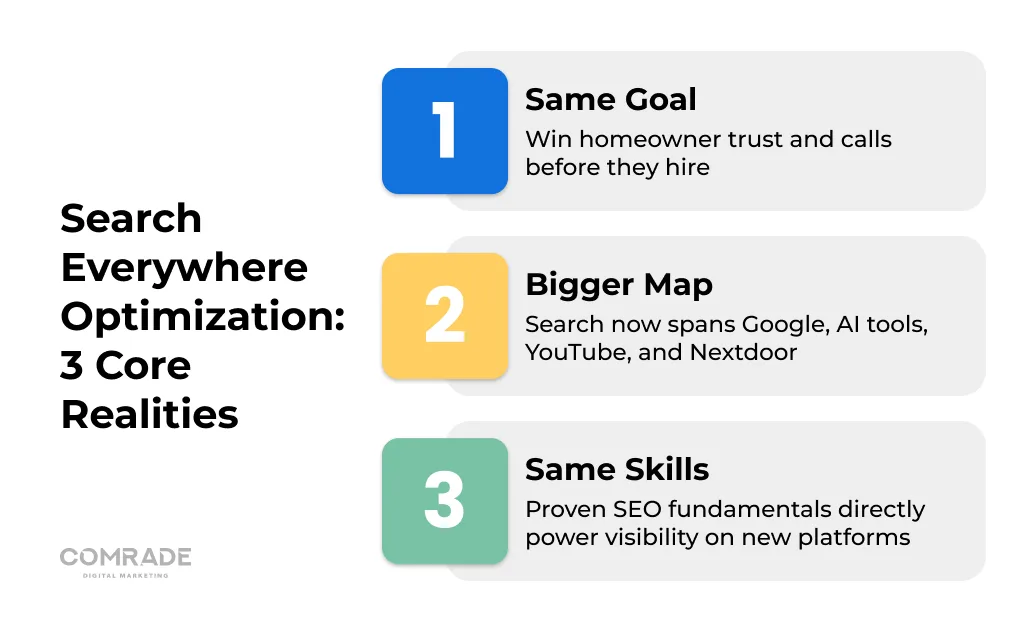
So, is SEO dead? Not even close. It just has a wider job description.
What Does Search Everywhere Optimization Look Like for a Real Home Service Business?
It looks like a rebuilt website, a cleaned-up Google Business Profile, and consistent details everywhere. Here’s how that played out for one contractor.
Absolute Home Services, a leading home improvement contractor in Ontario, Canada, came to us with paid ads doing the lion’s share of the work and thin margins to show for it.
Here’s what we did:
- Rebuilt the website and launched mini-sites for their top services
- Ran ongoing SEO
- Optimized their Google Business Profile
- Made their name, address, and phone number consistent across platforms
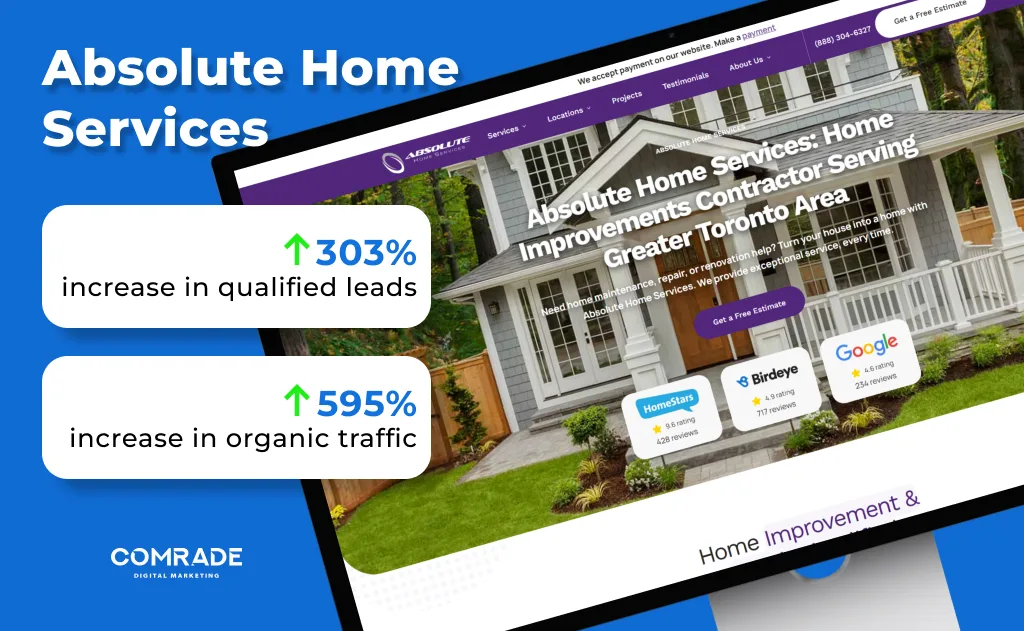
In plain terms: more qualified leads, with no ad bill attached to them.
All figures are non-paid only, comparing April–June 2023 with April–June 2025. Results vary by market, competition, budget, and starting point.
See the full Absolute Home Services case study
Where Should Your Contracting Business Start?
You don’t need to be on every platform. You need to be strong at the places homeowners check. For Megan, that was the map pack, ChatGPT, and her neighbors. Your customers might take a different route. Use this month to find out.
3 moves to make before the month is out:
- Ask your next 20 customers how they found you and where else they looked.
- Ask ChatGPT and Google’s AI Mode for the best [your trade] company in [your city]. See who gets named.
- Fix every mismatch in your name, address, phone number, and service list across Google, your website, and directories.
When you’re ready to act on this roadmap, explore how our SEO for home services contractors works. If you’d like a plan built around your business, talk to our team.
FAQs on Search Everywhere Optimization
-
What is search everywhere optimization in simple terms?
Search everywhere optimization means making sure homeowners can find and trust your business everywhere they look before they make contact: Google, Maps, ChatGPT, YouTube, Facebook, Nextdoor, and review sites. It builds on regular SEO and focuses on calls and booked jobs, beyond just rankings.
-
What does SEvO mean, and is it the same as SEOx?
Yes, they’re the same thing. SEvO and SEOx are both short for search everywhere optimization; different marketers just prefer different abbreviations. Some, like SparkToro’s Rand Fishkin, argue it’s still simply SEO with a bigger playing field. Whatever the label, the work for contractors is the same.
-
Is SEO dead now with AI?
No. AI tools like ChatGPT and Google’s AI Overviews draw on the same websites, Google Business Profiles, and reviews that SEO has always focused on. SEO isn’t dead. It just covers more ground now, from the map pack to AI answers.
-
Do I need a search everywhere optimization agency?
Not necessarily. A one-truck shop can handle the basics in this guide, like asking customers how they found you and fixing listings. A search everywhere optimization agency makes sense when you’re short on time, compete in a crowded market, or want help tracking results by channel.
-
How long does search everywhere optimization take to show results?
It depends on your market, competition, and starting point. Quick fixes, like completing your Google Business Profile and cleaning up listings, can make a difference within weeks. Building the reviews, content, and mentions that AI tools trust usually takes several months of steady work.
-
Which platform should a small contractor start with?
Start with your Google Business Profile and website. They’re where most homeowners check first, and AI tools read them too. Once those are solid, add 2-3 channels that fit your trade, like YouTube for HVAC or Pinterest for landscaping.
-
Does search everywhere optimization replace Google Ads or Local Services Ads?
No, it works alongside them. Google Ads and Local Services Ads put you in front of homeowners right away, while search everywhere optimization builds visibility that keeps working without a cost per click. Many contractors use ads to fill gaps while their organic visibility grows.