
Your phone rings like crazy after a storm, then goes silent for weeks. Even when it does ring, you’re not sure which channel is filling your inspection calendar. Frustrating!
Foundation repair isn’t like a $150 drain cleaning. You’re asking someone to hand over $8,000–$25,000+ on the promise that you’ll fix the very thing holding up their entire house.
They ask Google (or ChatGPT) about the symptom “why is my floor sloping?” research the cost, then read reviews. From there, they might shortlist three companies.
It’s a complex journey, and if you miss any one of those stages, you fumble the job.
We’ve spent 18+ years helping home service companies nail down which channels work, and which ones have the best ROI. We’ll break that down today, so you get more confident at filling your dispatch board in 2026.
Key Takeaways
- You’re marketing to two different buyers: the urgent “crack-widened-overnight” homeowner and the “legacy-crack” one who’s ignored the problem for years.
- Standard jobs run $5,000–$15,000, complex ones hit $30,000–$50,000+ — that kind of decision needs more trust-building than a coupon code.
- Respond within five minutes and you’re roughly 21 times more likely to convert.
- LSAs are the cheapest paid visibility you can buy — at $53 per lead, about half the cost of blended Google Ads.
- Your GBP is the highest-leverage free asset you own — the Map Pack captures the majority of “near me” clicks.
- Invest in phases: GBP, website, and reputation first, then LSAs and PPC for fast ROI, then SEO, content, and Meta to compound over time.
- The most common mistake is picking the right channel before the phase beneath it is ready to hold the weight.
Why Foundation Repair Marketing Is Trickier Than Any Other Home Service
You’re probably thinking: “Marketing is marketing — a lead’s a lead, right?” Not quite.
A furnace replacement gets booked in 24 hours. Foundation repair relies on trust, timing, and an inspection that takes weeks to schedule. It’s a longer decision cycle.
The typical home services playbook cracks under pressure here. This is why we’ve tailored this guide to cater to digital marketing for foundation repair companies only.
1. The Inspection-First Funnel
Your ad doesn’t get you the job. It gets you a phone number. The real funnel looks like this: ad/search → inspection request → on-site assessment → proposal → signed contract. That’s four steps standing before the contract.
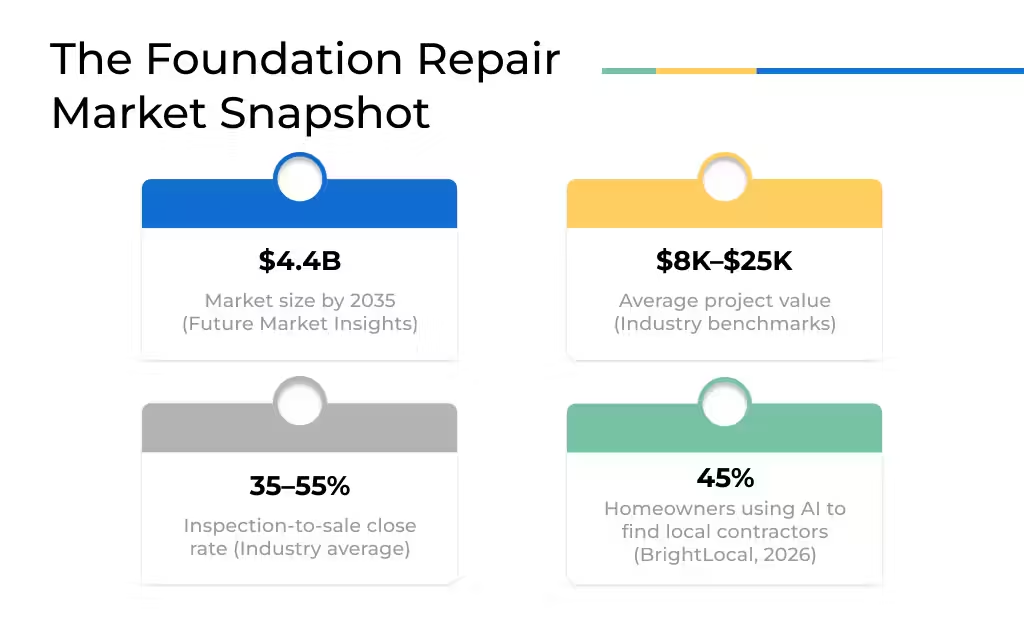
Inspection-to-sale close rates are somewhere in the 35–55% range. This means even a flood of cheap leads is worthless if half of them never let you through the door.
Pro Tip: Don’t just look at cost per lead. Look at cost per booked inspection.
2. Two Different Buyer Types
Meet Priya. She just watched a hairline crack expand overnight, and she wants someone out today. She’s your urgent buyer, easy to spot, easy to sell.
Then there’s Marcus. He’s been quietly living with a sticking door or a sloping floor for years, until a home sale forces the issue.
Most foundation repair contractors build one campaign, one message, one offer, aiming entirely at Priya. This means Marcus (the guy sitting on the bigger job) never even sees an ad that speaks to him.
3. High-Ticket Economics Justify Aggressive Investment
Standard jobs run $5,000–$15,000, and the complex ones — full underpinning, multiple piers, extensive waterproofing can climb to $30,000–$50,000+.
Homeowners are nervous. They’re about to drop several paychecks on this.
Here’s your in: Most home service verticals sell on convenience or price. Foundation repair sells on confidence. And confidence takes more touchpoints to build.
To justify a heavier, more sustained digital marketing investment for basement waterproofing, you must remember the ticket is bigger, the sales cycle is longer, and the homeowner needs far more reassurance.
4. Speed Always Wins the Lead
How quickly do you respond to leads? Homeowners search locally, and roughly 45% of consumers now use AI tools to find local contractors.
No matter where they come from, a real (human!) member of your team must respond to a lead within five minutes. That makes them roughly 21 times more likely to convert.
Homeowners routinely contact three to five contractors for the same job. Be the first one to respond, and you may just win their business over a less proactive competitor. Without good intake, no marketing for basement waterproofing companies can save you.
The 10 Best Marketing Channels and What They Cost
Not every channel deserves the same dollars.
Below, we’ve listed the 10 foundation and basement waterproofing marketing channels that produce booked inspections for foundation repair companies, including what each one is, what it costs, and what it gets you.
Once you’ve got the full digital marketing foundation repair picture, we’ll break down the exact order to invest in them.
1. Google Local Services Ads (LSAs)
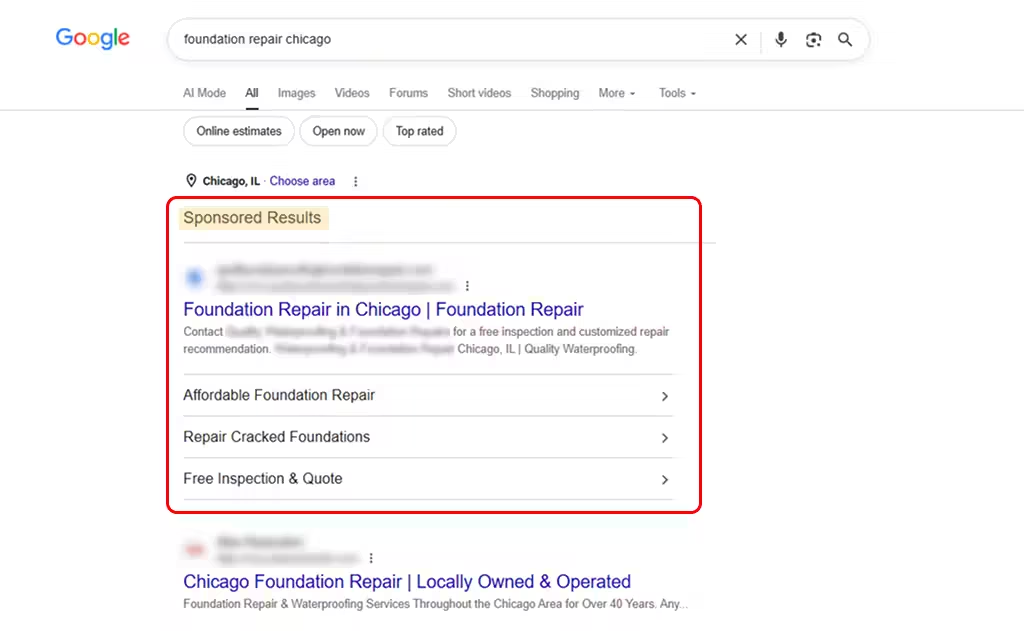
Why did we start with this? Because LSAs sit above regular ads. You get top-of-the-page visibility, with a credibility-boosting “Google Guaranteed” badge attached. You pay per lead (not per click), so a scroll-past costs you nothing.
At $53 per lead, LSA runs 49% cheaper than blended Google Ads’ $104 CPL. That’s roughly half the cost for the same visibility!
The trade-off: LSA leads turn into smaller jobs on average ($1,826 vs. $2,465 on PPC), since LSA skews toward smaller service and repair calls. For most home services, that would be an issue. But in foundation repair, it barely registers. Even a “small” job starts at $3,000+.
P.S. Your Google reviews show up on your LSA ads. Push your rating past 4.5 stars, and you’ll save 10–20% on cost per lead.
2. Google Ads (PPC / Search)
This is where you get full control. You own your keywords and landing pages. Unlike LSAs, there’s no auction sharing, with the “Google Guaranteed” badge doing the trust-building for you.
Yes, that control costs more per lead than LSAs, but it also catches the bigger, messier jobs that LSAs tend to skim past (like a $30,000 “full foundation underpinning cost” job).
Pro Tip: Don’t chase the cheapest lead. A $40 lead that books 30% of the time actually costs you more per signed job than a $60 lead that books 48% of the time. Run the math on cost per booked job always.
Symptom-based keywords like “cracks in foundation,” “house settling,” “uneven floors” run $8–$20 CPC (cost per click) and catch homeowners earlier, before they’re in full panic mode. PPC captures that kind of top-of-funnel education better than any other paid channel.
3. Google Business Profile (GBP)
LSAs and PPC get you paid visibility fast, but your GBP is the free channel that makes every other channel work better. It should already be humming by the time your ad budget kicks in.
The Map Pack is where 42% of prospects click on first. That’s a huge pool of your potential clients!
Local SEO and your Google Business Profile give you visibility for those “near me” searches (“foundation crack repair near me,” and “basement waterproofing near me”). This is the single highest-leverage free asset in your entire marketing mix.
By the way, Local SEO isn’t just your GBP. It’s citations. It’s NAP (name, address, phone) consistency across 40+ directories. Treat all your profiles like living things. Keep them active by feeding them photos, posts, Q&As, and review responses.
4. Facebook / Meta Ads
We’ve noticed so many foundation repair companies skip Meta Ads entirely. This is exactly why it’s cheaper than Google Ads.
LSAs, PPC, and GBP all catch homeowners who are mid-search, panicking, with a problem. Meta catches the ones who aren’t searching yet.
Wait… then why should you bother? Because this is where the “legacy-crack” buyer lives.
Two jobs for Meta Ads: retarget the visitors who almost converted (cheap, high-intent, easy setup, they already know your name), and the “legacy crack” buyer tolerating a problem they haven’t diagnosed yet (the sticking door, the hairline crack) before a home sale or insurance letter forces a decision.
Target homeowners aged 35–65, be zip-code specific (Meta’s targeting is phenomenal), with home improvement interest and homeownership signals. Here, you’re planting the seed before the urgency takes root.
5. Reputation Management and Reviews
Reviews aren’t really a channel. They’re the “rebar” running through every channel above it.
Remember how we said a higher star rating lowered your LSA cost per lead? That wasn’t a coincidence. Reviews quietly reinforce everything else on this list.
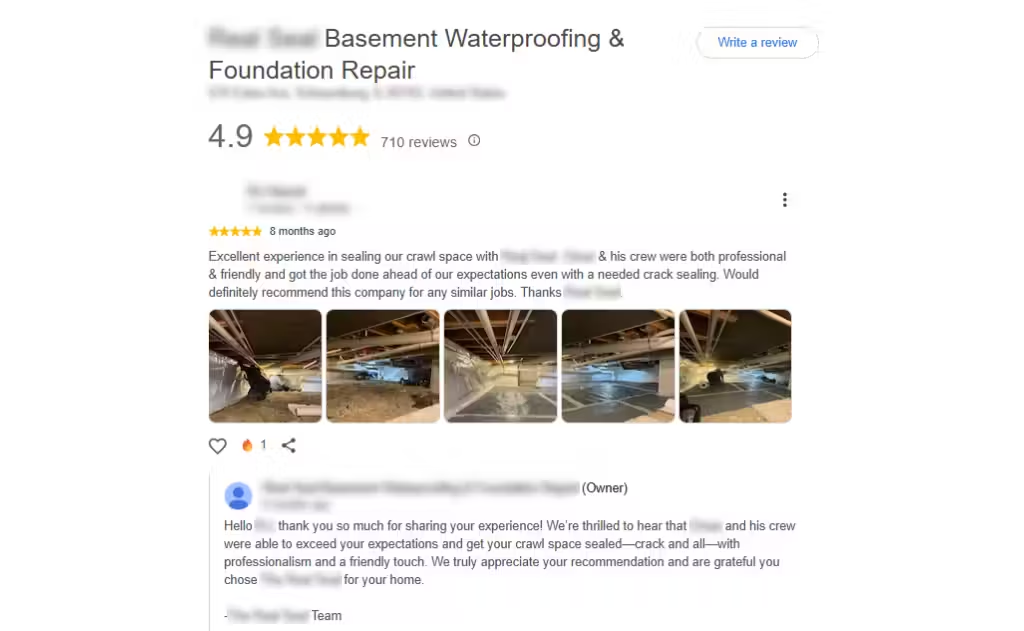
On an $8,000–$30,000 decision, strong 4- and 5-star reviews become the deciding factor. Homeowners rarely hire the first company they find. They read reviews, compare two or three options, and pick whoever feels trustworthy for a very expensive repair.
Rather than asking for each review manually, build the review ask into your CRM workflow right after every inspection. Aim for recency (steady monthly cadence) over raw volume.
A wall of 200 reviews from 2021 reads as abandoned. A steady stream of 10 reviews every month is more encouraging to a homeowner about to drop a huge sum.
6. SEO and Website Conversion Design
We explore the technical side in our foundation repair SEO guide. Here, we’ll focus on what your site needs to do the moment a homeowner lands on it.
Above the fold (before any scrolling), add: years in business, # of homes repaired, warranty terms, certifications, and a direct path to book an inspection.
Pro Tip: Do not have a five-field contact form standing between the homeowner and your calendar.
Given the steep price of foundation repair, you must front-load cost and financing content. Many potential clients delay foundation repairs because they’re afraid of what the cost will be.
Remove friction in your marketing for foundation repair by adding transparent pricing ranges and visible financing options in the top 20% of the page.
7. Content Marketing
Now that you have a basic grasp on conversion design, let’s get your content nailed down.
Start with symptom-based blog posts and FAQ pages that catch homeowners at the “Is this actually serious?” stage, before they’ve even typed the word “foundation.”
Roughly 1 in 4 American homes will experience some form of foundation issue during their lifetime. That’s a massive pool of homeowners who will search for answers. Your content is like a “bridge” straight to you.
You need pages that address the exact questions homeowners ask. Priority topics include:
- “How much does foundation repair cost in [city]”
- “Signs your foundation is settling”
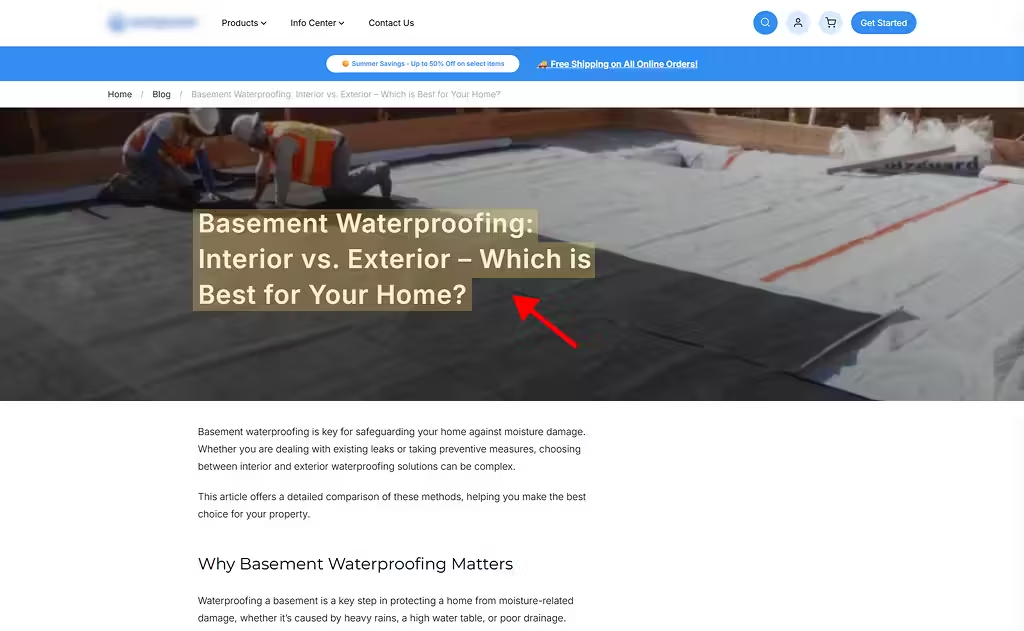
- “Basement waterproofing vs. interior drainage system”
In this niche, the content gap is wide open: most competitors don’t write anything at all. Show up first, and you could dominate foundation repair search for years.
Reminder: Every page needs a clear inspection CTA like “Book your free foundation inspection — no obligation.”
Do You Suspect There Are Cracks in Your Marketing? Run a Free Audit to See Where You're Losing Jobs.
(Free. 2 Minutes. No Card.)
8. Email Marketing and Retention
You’ve got your GBP, SEO, and content pulling homeowners toward you.
Now, email is where you nurture people who found you but weren’t ready to reach out yet… and the ones who already hired you, but might need you again someday.
This is the most underused channel on this entire list. Automated email sequences generate roughly 320% more revenue per email than one-off broadcast blasts. Unlike SEO, this makes email a “set it up once” channel.
Run automated email and SMS sequences that keep you top of mind. Make sure to add seasonal campaigns for past customers: maintenance check-ins, drainage tune-up reminders, referral asks.
In foundation repair, past customers refer more than most niches. They just dropped a ton of money and now trust you. When a friend mentions the same sticking door, your name comes up.
9. Direct Mail
But email isn’t enough. This is especially great for a legacy-crack buyer who isn’t searching for anything yet.
Every channel above relies on someone actively looking. Direct mail is how you reach the homeowner who hasn’t started looking at all.
Target zip codes with older housing stock (pre-1980), known clay or expansive soil, or a recent heavy rain event. These are the conditions most likely to be quietly cracking foundations right now, whether the homeowner’s noticed yet or not.
We would advise budgeting $0.50–$1.50 per mailer; expect a 1–3% response rate on a tightly targeted list. At a $12,000 average job, even the low end of that range pays for your campaign several times over.
10. Referral Programs (Real Estate Agents and Home Inspectors)
Speaking of reaching people who aren’t searching yet, this is a must-do.
Real estate agents and home inspectors are worth targeting with inspection partnership offers aimed directly at them.
But go beyond foundation repair social media marketing. We recommend a formal referral program with the agents and inspectors who flag foundation issues mid-transaction. They’re already standing in the crawl space when the problem turns up. You just need to be the name they hand over.
Keep it simple with a clear incentive (gift card, charity donation, reciprocal referral) and a dead-simple tracking process. This becomes your steadiest, low-cost lead source.
The Marketing Channels to Kick Off With (Do Not Start All at Once)
You just saw all 10 marketing for basement waterproofing channels. But don’t rush to launch yet. There’s an order to use them in to get the best ROI with the fastest lift-off.
This is like pouring a foundation one section at a time. Each pour needs to cure before the next one goes on top, or the whole slab ends up uneven.
Phase 1: GBP, Website, and Reputation (Foundation, Before Any Ad Spend)
The top foundation repair marketing companies will start here. This is the pour everything else sits on. Skip it, and every dollar you spend later works twice as hard for half the result.
- Google Business Profile, fully optimized: complete service categories (foundation repair services, waterproofing), photos uploaded within the last 90 days, and a review velocity that doesn’t look abandoned.
- A website that converts as a trust machine. Homeowner psychology from the first second on the page: trust signals above the fold, a direct path to booking an inspection, no long, generic contact forms.
- A reputation system baked into a process for requesting reviews after every inspection and every completed job.
95% of customers consult reviews before hiring, and it takes roughly 40+ to read as established rather than new. Nothing above this phase performs well until this one’s set.
Phase 2: LSAs and Google Ads (Month 1–3, Fastest ROI)
Once the foundation’s cured, this is where leads start moving fast. Here, your foundation and basement waterproofing digital marketing should focus on:
- Google LSAs. Pay-per-lead, Google Guaranteed badge attached: you pay for calls, and homeowners trust you on sight. Setup takes 1–2 weeks, including background check and license verification.
- Google Ads (PPC), alongside or right after. The strongest foundation repair companies run both at once to own the entire top of the page.
Foundation repair “near me” runs $15–$35 CPC; steep, but justified by $5,000–$25,000 project values.
This phase gets the fastest ROI on the whole list, which is exactly why it’s second: LSAs and PPC leads convert better once Phase 1 is there to catch them.
Phase 3: SEO, Content, Meta Ads (Month 3–12, Compounding Returns)
This is where the slower pours start paying you back without ongoing ad spend.
- SEO / Local SEO. High ROI, but it takes 6–12 months to compound. (Our Foundation Repair SEO guide goes deep on this.) Once it’s producing, CPL drops to $20–$50, and the leads are yours without paying per click.
- Content marketing. Symptom-based pages, cost guides, FAQ content. The content gap in this niche is enormous; most competitors aren’t writing anything at all.
- Facebook / Meta Ads. Start retargeting website visitors immediately. Layer in prospecting campaigns targeting zip codes with known clay soil or older housing stock: your legacy-crack demand generation.
“Warning-signs” content and Meta prospecting both land around $15–$35 CPL for inspection requests; comparable to paid search, but with a growing organic asset attached to it.
Phase 4: Email, Referrals, Direct Mail (Month 6+, Invest at Scale)
By now the foundation’s set, the fast channels are converting, and the compounding channels are climbing. This is where you widen the net.
- Email marketing for past customers: maintenance reminders, referral asks, seasonal campaigns.
- Referral programs with real estate agents and home inspectors.
- Direct mail for geo-targeted soil-risk zip codes.
- Retargeting across Google Display and Meta for site visitors who still haven’t converted.
Feeling overwhelmed? A good marketing agency for foundation repair companies can do this while you focus on running your crews.
Which Phase Should You Actually Be In?
| Business Stage | Phase 1 | Phase 2 | Phase 3 | Phase 4 | What to Avoid |
|---|---|---|---|---|---|
| New company (<1 year) | GBP + website: build now | LSAs: start here | Basic SEO once reviews build | Not yet | Starting with social only: it’s too slow |
| Established, <50 reviews | Review system: fix first | GBP + LSAs + PPC | SEO content | Not yet | Ignoring reputation before scaling ads |
| Growing, 50+ reviews | Already in place | Already in place | SEO content + PPC (deepen) | Email + referral | Spreading budget too thin across all channels |
| Multi-location / scaling | Already in place | Already in place | SEO authority + PPC (per location) | Paid social + display + direct mail + referral network | Treating each location as identical: geo-customize |
Find your row, and work left to right. The most common mistake we see is contractors picking the right channel at the wrong time, before the phase before it is ready to hold the weight.
But there are a couple more mistakes to watch out for.
6 Common Foundation Repair Marketing Mistakes
You’ve got the channels. You’ve got the order. But watch out, here’s where even good budgets crack under pressure.
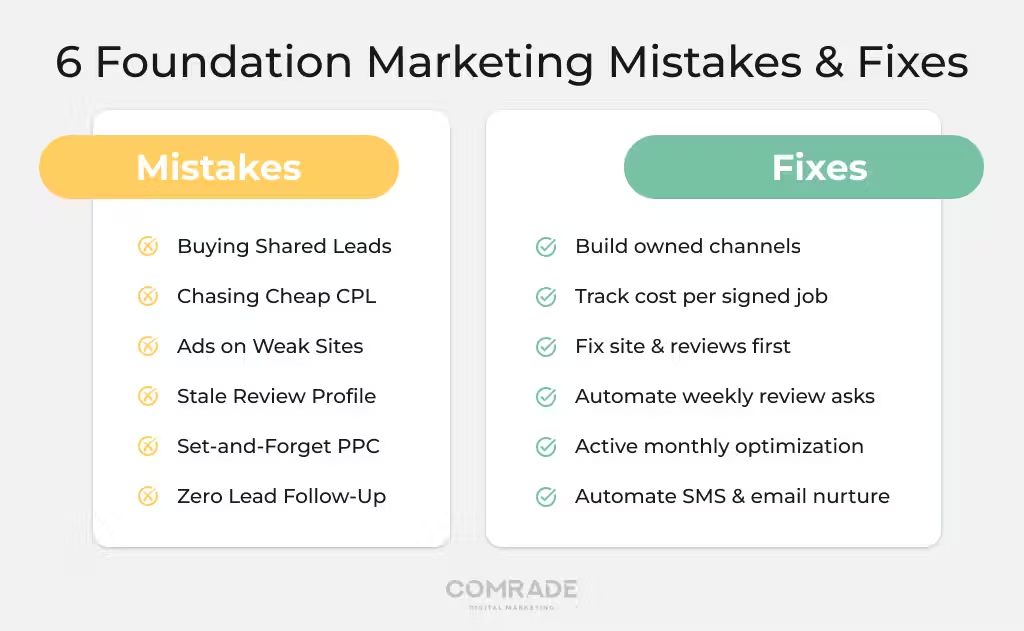
Mistake 1: Buying shared leads from lead generation platforms.
When a shared platform sells a “my wall is bowing” lead to five foundation companies, all five phones ring within minutes of each other. The fastest responder wins the job, but you’ve just commoditized yourself on price, and the platform keeps the funnel, the data, and the relationship. Build your own instead.
Mistake 2: Optimizing for CPL instead of cost per booked job.
A $40 Facebook lead that no-shows 70% of inspections is actually more expensive than a $120 Google Ads lead that closes at 55%. Track the full funnel: lead → inspection booked → inspection completed → job signed, or you’re optimizing for a number that has nothing to do with revenue.
Mistake 3: Running ads before the website and GBP are ready.
Sending paid traffic to a weak website or a GBP with six reviews is setting your money on fire. Expect to pay more per lead than most home services, since the jobs are high-ticket and the buyer is cautious, and a cautious buyer on a weak site doesn’t convert. They go back to Google and call the competitor with 200 reviews instead.
Mistake 4: Ignoring review velocity.
Most companies get a burst of reviews at launch, then go quiet for months. If your last review is from eight months ago and your competitor posted one yesterday, Google reads that as one active business and one that might be closed. Homeowners draw the same conclusion.
Mistake 5: Setting and forgetting paid campaigns.
Intense competition means companies often overspend on the wrong channels or fail to balance short-term lead generation with long-term growth. PPC in this vertical needs active negative keyword management, landing page testing, and a monthly bid strategy review. Don’t approach this as a set-it-and-leave-it strategy.
Mistake 6: Skipping the follow-up.
Most home service leads don’t convert on the first contact. Some are price-shopping, some are waiting on a spouse, some are months from pulling the trigger. Without an email or SMS follow-up sequence, you’re leaving a large chunk of the traffic you already paid for behind.
Book Consistently. Not Just After the Next Storm.
Right now, clients are out there. One’s Googling a symptom and seeing a competitor’s GBP; another is looking at a Facebook ad that’s not yours.
Every channel in this guide helps you capture their attention (and their business) before a competitor nabs that $8,000+ job right under your nose.
Don’t fall behind because of a visibility problem. You deserve better.
Since 2008, Comrade has grown 130+ contractors by building marketing that holds up with GBPs, reviews, LSAs, PPC, SEO, AI search, and everything after it.
Not ready to hire a foundation repair marketing agency yet? No pressure.
Start with a free Marketing Assessment to find out exactly which phase you should invest in right now.
Foundation Repair Marketing FAQs
-
What is foundation repair marketing?
It’s the mix of channels: GBP, LSAs, PPC, SEO, content, email, referrals, that gets homeowners from a Google or AI search to a booked inspection. Unlike most home services, it has to work across three distinct search stages: symptom, education, and action to capture homeowners at every stage.
-
How much should a foundation repair company spend on marketing?
Most companies land somewhere between 7 to 12% of revenue, higher if you’re newer or scaling fast. Given the ticket size ($5,000 to $50,000+ per job), even an aggressive spend pays back quickly if you’re tracking cost per booked inspection.
-
What is the best marketing channel for foundation repair companies?
There isn’t one “best”; there’s a sequence. GBP and reputation come first because they make every paid channel cheaper. LSAs and Google Ads deliver the fastest ROI. SEO and content compound over time and eventually become your cheapest, recurring lead source.
-
How long does it take to see results from foundation repair marketing?
LSAs and Google Ads can produce booked inspections within 1 to 2 weeks of launch. SEO and content take 6 to 12 months to compound but keep producing leads without ongoing spend. Reviews and GBP optimization show impact within 30 to 60 days.
-
Should I use lead generation services like Angi or HomeAdvisor?
Be cautious. These platforms sell the same lead to three or four competitors simultaneously, so you’re often just buying a shot at a bidding war. They can work as a supplemental channel once your own funnel is strong, but building your own pipeline gets you leads you actually own.
-
How do I market to homeowners who don’t know they need foundation repair yet?
Symptom-based content and Meta prospecting ads are the two channels built for this. Target searches like “why is my basement door not closing” and Facebook ads aimed at zip codes with older housing or clay soil. You’re planting the seed before the panic sets in.