
It’s 12 PM. Denise spots a new crack in her living room wall, panics, and Googles “foundation crack repair near me.” A few miles away, Chip runs a foundation repair company that could’ve taken her call. Instead, a competitor’s site ranks first, loads fast, and gets the job.
With foundation repair SEO, Chip could have nabbed that job, adding $2,200 to $8,000+ (the avg. cost of a foundation repair job) to his business.
Sick of missing out like Chip? A foundation repair marketing strategy will seal the cracks in your visibility.
In this guide, we drop our complete 2026 playbook to nail SEO for foundation repair companies and increase your booked inspections. P.S. You’re in great hands. This is hard-won knowledge, courtesy of our SEO experts who’ve been doing this for 18+ years. Let’s dive in.
Key Takeaways
- Not one, but three searches. Your foundation repair SEO keywords must cover symptom, education, and action.
- The Map Pack ranks above organic. A complete, active Google Business Profile is the fastest way to rank for nearly every local search.
- Truly local (no templates!). Pages with local landmarks, actual soil types, neighborhoods, and testimonials are better than a page with just the city name swapped.
- Real estate closings are wide open. Most competitors never build dedicated pages for this high-urgency, high-paying lead source.
- A slow site kills everything else. Technical SEO (speed, mobile-first design, HTTPS) is the floor everything else stands on.
- Schema and real backlinks close the loop. Together, they give Google what it needs to trust and rank you.
What Is Foundation Repair SEO?
While Denise Googles “foundation crack repair near me,” her neighbor, John, Googles “why is my basement door not closing?”
Two types of searches. Both click on the same top-ranking contractor on Google.
That’s SEO (search engine optimization) working its magic!
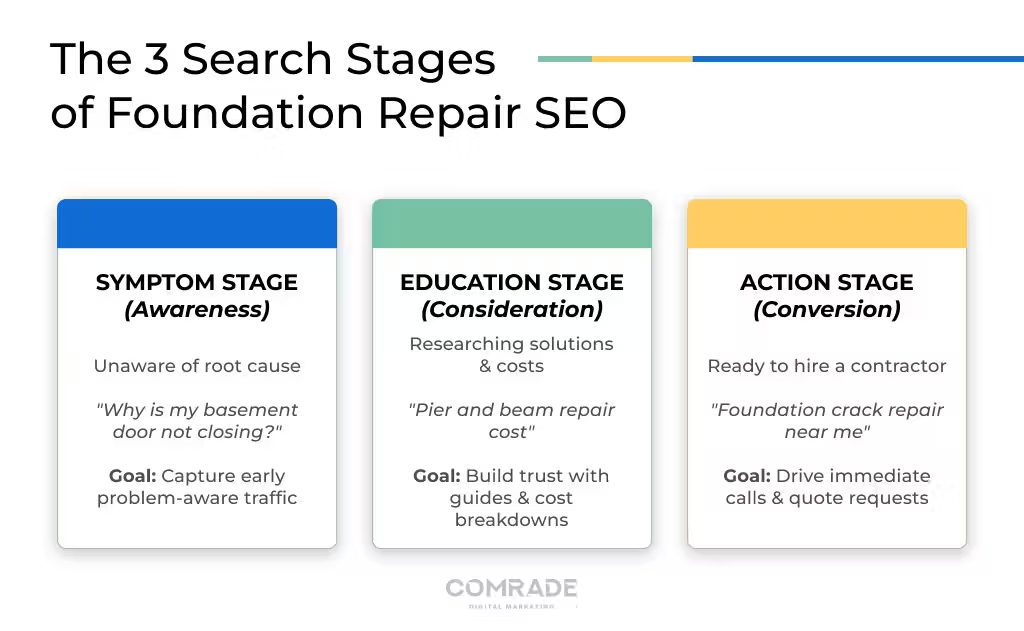
So, what is foundation repair SEO? Foundation repair SEO is the practice of optimizing your website so it shows up on Google at every stage of a homeowner’s search. It covers three distinct moments:
- Symptom stage — they don’t know it’s a foundation problem yet (“why is my basement door not closing”)
- Education stage — they suspect it’s serious and want to understand it (“pier and beam repair cost”)
- Action stage — they’re ready to hire (“foundation repair near me”)
That’s exactly why Denise and John found that website. Denise landed on the “Action” stage, ready to hire. John was still stuck on the “Symptom” stage, not even sure he needed help yet. An SEO-friendly site captures both.
But foundation repair SEO differs from foundation repair local SEO. The latter usually only targets “near me” searches.
General foundation repair digital marketing SEO ranks you for the “Symptom” and “Education” stages as well, not just the “Action” stage.
There’s a bonus, too: The same well-structured, trustworthy content that ranks on Google is exactly what ChatGPT, Gemini, and Google’s AI Overviews pull from when a homeowner asks them for a recommendation. Build this and your AI SEO for foundation repair contractors comes along with it!
What about paid ads? Foundation and basement waterproofing SEO are built very differently than ads. We’ll cover that below.
Why Foundation Repair SEO Has the Highest ROI in Home Services
You’re probably asking: “Is foundation repair SEO even worth it? Should I bother?”
When done correctly: Yes, it’s worth it! Let’s compare the economics between paid ads and SEO.
| Paid Ads | SEO (Organic) | |
|---|---|---|
| Cost per lead | $150-180 per lead for Google Ads and $60-75 for LSAs per foundation repair lead | As low as $31 per lead, as per the Martal Group |
| Return on spend | Across industries, PPC delivers a 200% ROI. That’s $2 back for every $1 spent. | Across industries, SEO delivers a 748% ROI. That’s $7.48 back for every $1 spent. |
| Stops producing when… | You stop paying | Doesn’t stop, keeps ranking |
| Compounds over time | No, resets to zero the moment your budget stops | Yes, the same page can keep producing calls 18+ months later |
In case you missed it, a $1,000 investment in PPC gets you roughly $2,000 back. That same $1,000 put into SEO gets you closer to $7,400+. That’s over $5,500 more for your foundation repair business.
Referrals, on the other hand, are unpredictable. There’s no dollar figure to compare because you can’t budget for them or turn up the volume when work slows down.
There’s a real case here for foundation repair lead generation through SEO instead of PPC or referrals.
Semrush reports that over 60.5K searches for “foundation repairs” happen every single month nationwide. In your market alone, that could mean thousands in new revenue.
With SEO, a campaign you launch today can still generate leads 18+ months from now, long after a paid campaign would have run dry. Unlike paid traffic, foundation repair organic traffic keeps growing, and growing, and growing!
That’s the ROI of foundation repair marketing: Pay once. Get paid for years.
But there’s a method to SEO. Just like in your line of work, we begin with a strong foundation. And that starts with keywords.
97% of Homeowners Search Online. Curious to See How Many of Those Jobs Land on Your Calendar?
(This takes just 2 minutes!)
1. Create Strong Foundation Repair Keyword Clusters
Why keywords first? Because keyword clusters are like your site survey.
Everything you build on top eventually cracks if you don’t do this first in your SEO keywords for foundation repair strategy.
Think about it this way: You could spend the next three months optimizing for “foundation repair” meanwhile, your client is Googling “why is my basement wall bowing?”
That’s three months of budget optimized for the wrong audience. Painful!
So what is a “keyword cluster”? A keyword cluster is a group of related search terms that share the same intent: the same homeowner, at the same point in their decision, just phrasing it differently.
| Cluster | Homeowner’s Thought Process | Example Keyword Cluster |
|---|---|---|
| Symptom | “Something’s wrong with my house, but I don’t know what to call it yet.” They’re describing what they see, not diagnosing it. | • sticking doors • cracked drywall • uneven floors • bowing basement walls • hairline wall cracks • gaps around window frames • sloping floors • musty basement smell • foundation settling signs • floor separating from wall |
| Education | “Okay, it might be my foundation. What does that even mean, and what am I in for?” They’re researching before they trust anyone with a quote. | • foundation repair costs • lab repair keywords • pier and beam vs. slab repair • foundation repair methods • how long does foundation repair take • cost of underpinning • foundation repair financing • average cost to fix foundation cracks • foundation repair warranty • DIY vs. professional foundation repair |
| Action | “I know what this is. I need someone out here now.” They’re ready to hire, the only question left is who. | • foundation repair near me SEO • foundation repair company near me • [service] + [city] • same-day foundation inspection • emergency foundation repair • free foundation inspection near me • best foundation repair company • licensed foundation contractor near me • 24/7 foundation repair service • foundation repair quote near me |
Miss a cluster, and you miss that homeowner entirely.
That’s the risk of targeting foundation repair “near me” SEO terms alone. You win the homeowner who’s already decided, and miss the one who’s still figuring it out.
So, whether you’re targeting foundation crack keywords or slab repair keywords, make sure you first build out a foundation repair long-tail keyword SEO strategy.
Assign keyword clusters for each stage: Symptom. Education. Action.
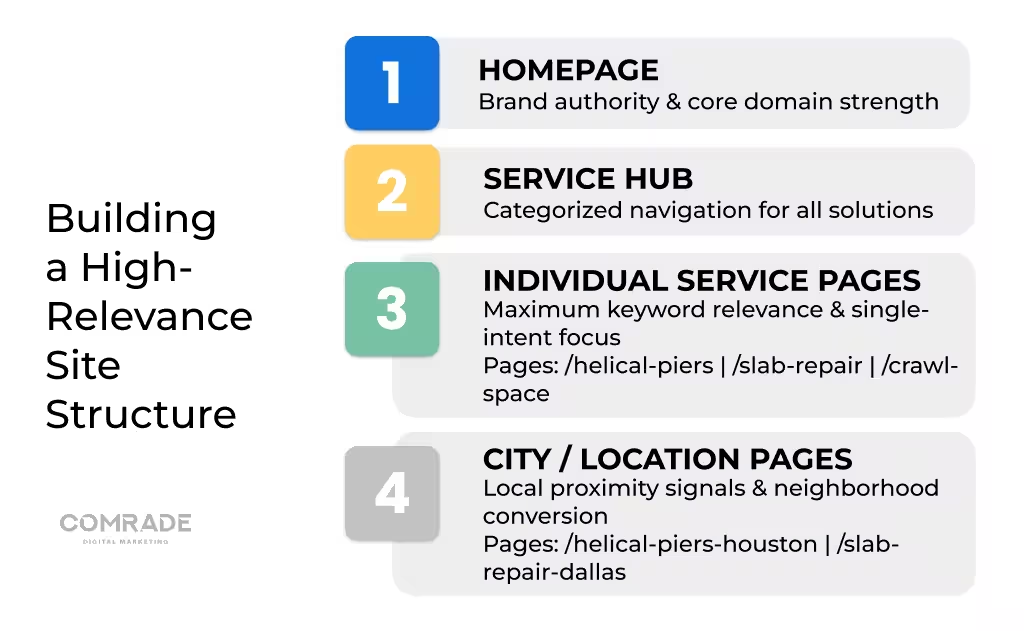
2. Use Service-Specific Page Architecture
Have your keywords? Nice! Now, let’s put up the walls around them.
One rule here: Do not cram every keyword onto one page.
Let’s look at a hypothetical. Let’s say your company handles slab repair, pier and beam, helical piers, mudjacking, crawl space work, waterproofing, and bowing walls.
One page cannot rank well for seven unrelated searches. It won’t hold the load. Dedicated pages are like separate, engineered pours.
Google itself claims, “Local results are mainly based on relevance, distance, and prominence.”
“Relevance” means how closely your page matches what someone actually searched for.
To prove relevance, we would need dedicated foundation repair service pages.
For “helical pier installation,” your clients want a page built around helical pier installation SEO. Same for slab foundation repair SEO. Same for the crawl space repair page.
Unbounce even reports that home improvement landing pages see a 2.6% conversion rate, but the top performers convert at 19.5%! One of the best ways to inch closer to 19% is to have dedicated pages.
And remember, one generic “Services” page misses long-tail intent entirely. Nobody searches “foundation services.” They search specific, longer phrases like “helical pier installation cost” or “crawl space encapsulation vs. waterproofing.” A generic page can’t rank for language that specific.
But you’re not done yet. Your pages are relevant. Next, Google needs to see distance and prominence. That starts with your Google Business Profile.
3. Google Business Profile Optimization
You need a strong, active Google Business Profile. Why?
Because nobody hires a contractor whose business looks like it went out of business.
With a GBP, you show up in the foundation repair Map Pack. This fires for local searches like “drywall repair Chicago” and places you even above regular organic listings.
Remember: Your Google Business Profile and reviews aren’t decoration. They’re load-bearing. Pull them out, and the rest of your local SEO foundation repair structure crumbles.
Google even confirms, “A verified Business Profile can help customers find you and build greater trust in your business.” So, how do you build yours?
- Set “Foundation Repair Contractor” as your primary category: don’t just choose “General Contractor” or “Home Improvement.” Add secondary categories like “Waterproofing Company” to widen your relevant searches.
- Post job-site photos weekly: the crack, slab, or crawl space you just fixed, captioned with the service and city. Steer clear of AI or stock images. Anyone can post those.
- Time your Google Posts to real regional triggers: after heavy spring rain saturates the soil, or when summer drought causes clay soil to shrink and crack foundations.
- Seed the Q&A section yourself with the three questions every homeowner asks: cost, timeline, warranty, before a competitor (or a wrong answer) beats you to it.
- Text every customer a review request within 24 hours of job completion: while the repair is still fresh in their mind, they’re far more likely to mention specifics (the crack, crawl space, timeline).
All of these steps are key to your Google Business Profile foundation repair optimization.
Show up on foundation repair Google Maps, and you’ll get local clients.
But beware: A thin, neglected profile is not enough. You need to keep your GBP accurate and collect reviews to ace your local SEO for foundation repair contractors. Speaking of…
Ready to put your business at the top of the map? Discover proven tactics in our guide to Google Maps Marketing.
4. Create a Review Strategy and Collect Social Proof
You’re gaining traction with your GBP, but potential clients still aren’t convinced. They need proof.
A foundation job isn’t a $50 drain cleaning. It’s $2,000+ of structural work on the one thing holding up their house.
Nobody hands that over to a stranger. They need to see several 4- and 5-star reviews, ideally from neighbors in their own zip code. That’s where you need foundation repair reviews SEO.
Remember, Google weighs volume, velocity, recency (and how fast you respond to each comment). A profile with 80 reviews from six months ago won’t be as impressive as one with 40 from last month when it comes to Google reviews foundation repair searches.
Wondering how to get more foundation repair reviews? Automate the ask.
Text message click-through has been sliding according to Birdeye, from around 8% in 2023 down to roughly 6% in 2024 due to spam filters and AI scam texts.
Luckily, email hasn’t slipped the same way, partly because it scales better through CRM automation.
A simple review template you can copy: “Hi [Name], thanks for trusting us with your [service] repair! If you have a minute, we’d love a quick review: [link]. Your review helps your neighbors make the right call when they spot the same kind of crack.”
More Good Reviews reports, “Many customers leave reviews because they want to help fellow consumers make informed decisions.”
Remember that. When asking for a review, appeal to their sense of community responsibility.
And whether you get a positive or negative review, respond within 24 hours, calmly and publicly. How you handle criticism sells the next job as much as 5 stars does.
5. Optimize Your Title Tags, Meta Descriptions, and Headings
The reviews are rolling in. We’re making progress!
Now that your site is ranking on Google, we still need it to get clicked to bring traffic there. That’s why we need foundation repair on-page SEO.
To earn the click, what helps is having a strong title tag for each page.
Bad title tag example: “Foundation Repair Services.”
Good title tag example: ” | Free Same-Day Inspection.”
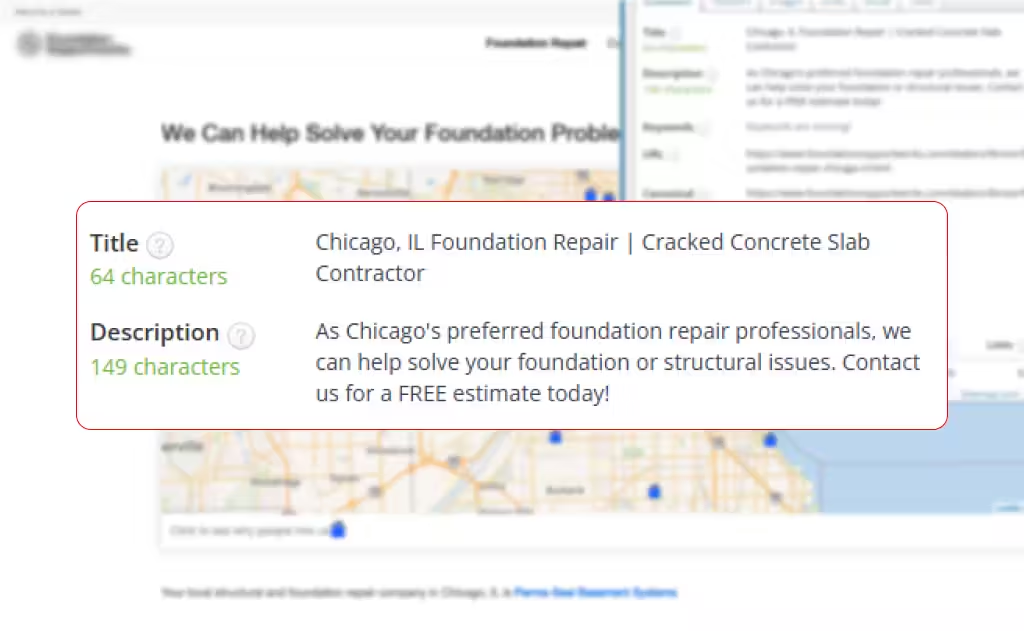
The first tells Google nothing. The second nails location and urgency at once, helping with your SEO for basement waterproofing and foundation repair efforts.
Title tags for foundation repair pages need city names and a clear service. Meta description foundation repair copy should add a trigger like “same-day” or “free estimate”: something that makes clicking feel urgent.
Have your H1/H2/H3 mirror your keyword layers, and write real alt text (like “slab foundation repair crew pouring concrete piers in Tulsa”) instead of “image1.jpg.” Lastly, be sure to link every page back to the city and service pages beneath it.
6. Build Hyper Local Landing Pages
Your title tags are dialed in. Now let’s look at your location.
As a hypothetical, let’s say you serve Texas. It runs nearly 800 miles and holds more than 1,200 incorporated cities. You can’t serve all of them. You must narrow it down to the handful within reach of your crew: E.g., Fort Worth, Arlington, and Grapevine.
But you can’t build one page for “DFW foundation repair” and swap the city name for Arlington and Grapevine. Google hates thin, templated content like that.
A real local page has specific landmarks, local testimonials, and genuinely unique content for that city.
| Generic Template | Real Local Page |
|---|---|
| “We serve [City] and the surrounding area.” | Names the actual clay-heavy soil that causes foundation shifting in that county |
| Same AI / stock photo on every page | References specific neighborhoods you have worked in |
| Same three sentences, city swapped | Explains how that city’s heavy spring rain saturates soil differently than the next town over |
| No proof it’s local | A local testimonial from an actual customer in that city, by name |
Once your local pages exist, they need something to link out to.
Your Fort Worth page, for example, should link to a blog post like “Why Tarrant County’s Clay Soil Causes Foundation Cracks,” not just sit there as an island.
Strengthen your content foundation with a web of unique, city-level, interconnected content, and you’ll improve your local rankings across the board.
7. Leverage Content Marketing
Your local pages are live. Next, you need foundation repair content marketing to drive traffic to them.
Even the prettiest website is useless if no one finds it.
We suggest building your content calendar around three keyword layers, each with 20+ topics feeding straight into each service page.
Symptom-stage foundation crack content ideas: vertical vs. horizontal cracks, stair-step brick cracks, sticking doors after rain, uneven floor checklist, musty basement smell, window gap causes, foundation settling signs, hairline crack risk.
Educational-stage foundation repair blog topics: slab repair cost guide, pier and beam vs. slab, helical piers vs. mudjacking, repair timeline explained, warranty comparison, DIY vs. professional repair, financing options, spring rain vs. summer drought damage.
City-specific spins for extra reach: Tarrant County clay soil, Arlington foundation settling, Grapevine soil moisture, Fort Worth crawl space guide, North Richland Hills soil report.
That’s 21 blog topics (each one is great for your educational content foundation SEO), catching readers at their precise stage of research, then linking them straight to your service pages. Pretty smart, right?
Highly local, quality content is also a huge signal of E-E-A-T (Experience, Expertise, Authoritativeness, and Trustworthiness), which is a framework Google uses to evaluate the quality of web content.
8. E-E-A-T for Foundation Repair
Speaking of E-E-A-T, what is it? Let’s dive deeper.
Google wants proof you’re not just some random person online writing about foundation repair. It wants to see that you actually do this work for a living.
E-E-A-T foundation repair SEO means you show real foundation repair expertise signals:
- Your CBIS credential
- A link to your state licensing page
- Before-and-after case studies with actual measurable outcomes (not just photos)
- A real author bio on every article, not “Admin.”
Add third-party citations where you can: an engineer’s report, a building code reference. That’s good contractor authority SEO.
Thin pages don’t just underrank anymore. Google actively penalizes them, especially on a topic this structural.
This even takes into account AI-generated content. In July 2026, Google issued a manual action against a major Windows tech-support/discussion forum for “thin content with little or no added value,” suppressing over 168,000 threads at once, despite the site ranking fine for nearly 20 years.
SEOs traced the likely cause to an AI chatbot that had auto-posted more than 100,000 replies since 2023, since AI-generated answers lack the real human experience Google’s E-E-A-T standard is built to reward.
This means AI content by itself is not being penalized. But thin, generic AI content that doesn’t have your personal expertise will be.
9. The Real Estate Pipeline: An Underused Lead Source
Your blog and E-E-A-T are both solid. But here’s a lead source you’re probably ignoring entirely: real estate closings. You need foundation repair for a home sale.
Imagine this: A home inspector flags a foundation issue mid-sale. The seller suddenly needs a repair quote in days, or the deal falls through.
That urgency rivals an emergency call, and it pays a premium, since nobody’s shopping three quotes with a closing date looming.
Here’s what your site needs to capture it:
- A dedicated page: “Foundation Repair Before Selling Your [city] Home,” separate from your general slab repair page, built specifically for this urgency
- Keywords: “foundation repair before selling house [city],” “foundation inspection real estate closing [county],” “pre-listing foundation inspection [city / county]”
- GBP categories: add “Real Estate Inspector” or “Home Inspector” as a secondary category, since that’s who sellers’ agents search for first.
Most competitors never touch this pipeline, which is exactly why it’s wide open. Foundation repair before selling house SEO is the fastest way in.
But hey, none of this matters if your site itself is slow to load or breaks on a phone. This brings us to the technical floor everything else stands on.
10. Technical SEO for Foundation Repair Websites
None of the nine points above matter if your site chokes on a phone.
Your next client is standing in a flooded crawl space and can’t wait.
Over 78% of foundation repair searches in 2026 are local and mobile-first, making local SEO the highest-ROI channel for contractors — IF the site actually loads.
A slow, uncrawlable site is shallow footing, everything above it is at risk.
So, how do you put your technical SEO foundation repair to work? Core Web Vitals, HTTPS, and a site architecture built flat rather than deep, so Google can crawl every service and city page in a click or two. An XML sitemap tells Google exactly what exists, instead of hoping it stumbles onto your page eventually.
Mobile SEO foundation repair company checklist, self-audit style:
- Loads under 3 seconds on a phone
- Passes Core Web Vitals in Search Console
- Runs on HTTPS, no mixed-content warnings
- Every page is three clicks or fewer from the homepage
- Sitemap submitted and error-free
Your foundation repair website speed is the floor everything else in this guide stands on. Make it structurally sound.
Does the list feel confusing? Got no time to manage it on top of running jobs? That’s exactly the kind of work our agency handles so you don’t have to on a random weekend. Contact us today.
11. Schema Markup for Foundation Repair
Your technical floor is solid by this point. Next, use schema to tell Google exactly what each page means. Schema markup for foundation repair companies falls into four baskets:
- LocalBusiness schema contractor tags — hours, address, phone, service area
- Review/AggregateRating — star ratings displayed right in results
- FAQ schema home services — expandable Q&A directly in the SERP
- HowTo schema foundation repair — for process content like “how pier installation works,” which can win featured snippets
Each type triggers a different SERP feature. Here’s illustrative LocalBusiness markup:
json
{
“@context”: “https://schema.org”,
“@type”: “LocalBusiness”,
“name”: “Example Foundation Repair Co.”,
“address”: “123 Main St, Fort Worth, TX”,
“telephone”: “+1-817-555-0100”,
“areaServed”: [“Fort Worth”, “Arlington”, “Grapevine”]
}
Got your schema sorted? Don’t rest yet. Getting found is half the equation. The other half is getting other sites to vouch for you.
12. Link Building Strategies for Foundation Repair Contractors
That’s what backlinks are (other websites linking to yours). Each one tells Google that a credible source trusts your content enough to point to it.
There’s a tempting shortcut: link farms (networks of low-quality sites built solely to link to each other and manipulate rankings). Skip them. Google actively penalizes sites caught using these schemes. Even one penalty can undo the other 11 steps in this guide.
We like to say: Foundation repair link building isn’t about volume. It’s about the backlinks foundation repair website authority.
How do you do authoritative foundation repair link building?
| Strategy | Where to Get It | Concrete Move for You |
|---|---|---|
| Linkable asset | Homeowners and local sites naturally link to free, genuinely useful tools | Build a “Foundation Repair Cost Calculator” and a crack-identification guide that homeowner forums and neighborhood blogs link to |
| Guest posting | Home improvement, real estate, and construction trade publications | If in Texas, pitch Fort Worth Business Press or the Texas REALTORS magazine a piece on “What Home Inspectors Flag Most in DFW” |
| Local link building | Chamber of commerce, HOA partnerships, real estate agent referral networks | Join the Fort Worth Chamber of Commerce for a directory listing, sponsor a Ryan Place or Arlington HOA newsletter, and get listed as a “preferred vendor” on a local Realtor’s resource page |
We must emphasize quality over quantity. 100 relevant local SEO backlinks from contractor sites will outrank 500 generic links from low-quality sites.
How Do You Measure Foundation Repair SEO Results?
Your reviews are growing. Links are building. Local pages are live.
But is any of this actually working? These are the foundation repair KPIs that you must track every single month:
- Organic sessions on service and city pages
- Map Pack visibility
- Phone calls from organic traffic
- Inspection form submissions
- Keyword rank movement on core terms
These foundation repair SEO metrics can be tracked across four tools:
- Search Console and GA4 for the basics
- BrightLocal for measuring local SEO success in rank tracking
- CallRail for foundation repair conversion tracking: tying every call back to the exact page that generated it
Track these five, and you’ll know precisely what’s producing booked inspections in your market. Any good local SEO services for basement waterproofing will track these first.
But even if you track your KPIs like a hawk, a few recurring mistakes quietly undercut results.
7 Foundation Repair SEO Mistakes That Are Costing You Leads Right Now
- You’re targeting “foundation repair” with no city modifier. Wondering why your foundation repair website isn’t ranking? That means you’re fighting national directories and out-of-town contractors for a term you’ll never rank for. Add the city to every title and page instead.
- You’re running a one-page service site. One page can’t rank for seven completely different repair methods at once. Split it into dedicated pages for each service.
- You’re skipping Google Business Profile photos. A bare profile looks abandoned and ranks lower in the Map Pack. Post real job-site photos after every job. This is one of the foundation repair SEO problems easiest to fix.
- You’re publishing thin city pages with just the name swapped. Google and homeowners both spot the template instantly. Add real local detail (soil type, landmarks, testimonials) to every page.
- You’re ignoring E-E-A-T. No credentials, no case studies, no real author bio, and Google buries a topic this structural. Add your licensing, real case studies, and an actual byline. This is one of the biggest foundation repair SEO mistakes.
- You’re not asking for reviews. Reviews you don’t request mostly never happen on their own. Automate the ask within 24 hours of every job.
- You’re treating SEO as a one-time project. A site optimized in 2023 and left alone loses ground every month a competitor keeps publishing. Budget for it as an ongoing cost.
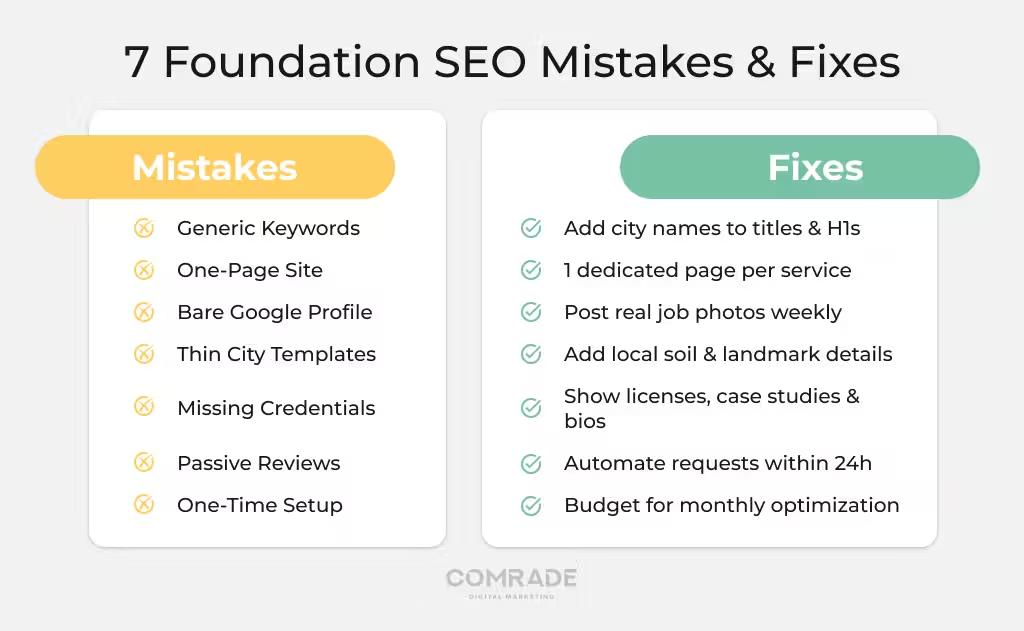
Any competent local SEO services for basement waterproofing company will tell you to watch for these seven mistakes and rectify them immediately. They could make or break your pipeline.
Ready to Rank #1 for Foundation Repair in Your Market?
Right now in your market, a homeowner is Googling “foundation crack repair near me.” You don’t show up. That job rushes into the arms of a competitor.
Foundation repair SEO services rectify your visibility issues and book you more qualified inspections all year-round. More calls. Better-quality leads. Rankings that keep compounding long after you’ve stopped thinking about them.
Since 2008, Comrade has helped 130+ contractors rank higher and stay booked with quality work.
Not ready to hire a foundation repair SEO company yet?
No worries. Start with a free, online Marketing Assessment today, and find out if you need foundation repair marketing help.
Foundation Repair SEO: Frequently Asked Questions
-
How much does foundation repair SEO cost?
Our foundation repair SEO cost starts around $3,000/month for a steady-growth package, scaling up to $5,500+/month for full-speed campaigns with more content, link building, and custom reporting. Results vary based on your starting point: a site with zero local presence needs more upfront investment than one that just needs a refresh.
-
Is local SEO or Google Ads better for foundation repair?
They’re not competitors. They solve different problems. Ads get you visibility much quicker (usually within one to two weeks). The foundation repair SEO results timeline takes around 6-12 months to build rankings and generate leads, but that compounds for years. Most successful contractors run both, using ads to fill gaps in your pipeline while your organic rankings build steadily in the background.
-
How do I rank for “foundation repair near me”?
To rank for “foundation repair near me,” start with a fully optimized Google Business Profile, dedicated city and service pages, and steady city-level reviews. Your Map Pack rankings respond fastest to relevance, distance, and prominence combined, so the more complete and active your profile, the faster you’ll climb.
-
What keywords should a foundation repair company target?
The best keywords for foundation companies cover all three search stages: “Symptom” terms like sticking doors or wall cracks, “Educational” terms like repair cost or pier vs. slab, and “Action” terms like foundation repair near me or [service] plus [city]. Skip a stage, and you skip that homeowner.
-
What is the realistic timeline and expected ROI for foundation repair SEO?
How long does foundation repair SEO take really depends. Expect early movement in 3-4 months and meaningful lead volume by months 6-9. That’s the foundation repair SEO timeline most contractors see, and because pages keep ranking without ongoing ad spend, your ROI typically keeps improving the longer the campaign runs.
-
How do I get more foundation repair leads?
Combine the fundamentals in this guide: dedicated service and city pages, a fully optimized GBP, and steady reviews with the often-overlooked real estate pipeline, where inspection-triggered repairs create fast-moving, high-value foundation repair leads most competitors never bother chasing.